Just the facts? From journalism to thriller writing
Updated: Aug 17
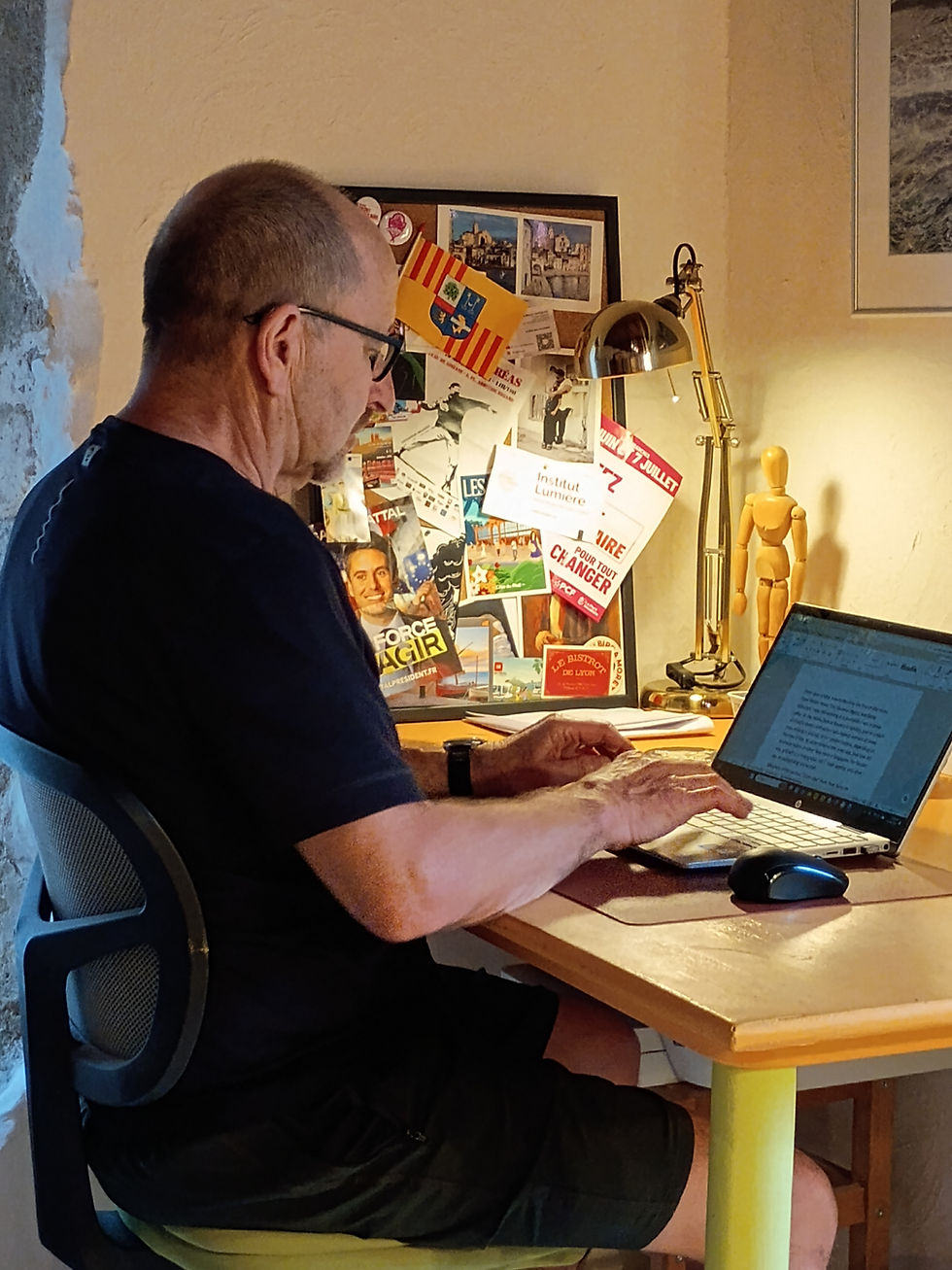
Once upon a time, around when I first started thinking about writing thrillers, I was working as a journalist.
I was a senior editor on the World Desk at Reuters in London, one of a team of about a dozen such editors who helped oversee all news copy moving in and out of the London bureau, depending on the hour. At other times of the news day, that task fell to similar teams in either New York or Singapore, for Reuters was, and still is, a truly global, 24/7 news agency and an outstanding one at that.
Members of the London “chief subs” team took turns on various shifts, and once every two months or so it was one member’s unlucky turn to man the London desk, alone, all through the night, for seven nights in a row. The major Reuters editing, and reporting action was elsewhere for those hours of approximately 11pm to 7 am London time. But it was thought that having one person on shift in London throughout the UK night was still essential, even though editors in Singapore were then actually in charge of the wire.
Most of that shift, I, or another sleep-deprived journo, would watch various TV and computer screens for signs of action on our turf that needed immediate attention. That turf extended from western Ireland to Israel, and from Scandinavia/Russia to South Africa.
It was a bit like babysitting. Stay awake in case something alarming happened when everyone else is supposed to be asleep. Listen for bumps in the night. Make sure the baby is still breathing. Let the cat out. The Singapore desk, meanwhile, would watch over and post news reports from world neighbourhoods that were supposed to be awake.
It was usually a reasonably quiet shift. A bit of routine updating of stories that had moved out on the news wire earlier in the day, mostly, and preparing a news outlook for the following day; that sort of thing. But sometimes there was a bump in the night that caused the London editor to sit up and take notice and move a news item. A bomb in an apartment building in Moscow, for example, at 0300 h London time, or a new spot of bother in the West Bank as people there started to wake up, or maybe a bus crash down in Zambia.
But in the truly quiet hours, I could watch out for this and that and still have some time to daydream a little. I was proud to be working at Reuters, of course, where facts were sacrosanct, and fastidious sourcing and source-checking, and the immediate and careful correction of any errors, were mandatory. These were articles of faith. Nonetheless, I was getting a little bit fed up with “just the facts”.
I found myself wanting to make things up. Not when I was actually working on the World Desk, of course. I wouldn’t have lasted five minutes on the Reuters staff if I made things up at work. But in my off hours, I started, indeed, to make things up. The Mazovia Legacy, my first thriller, was the initial result. Other thrillers (The Burma Effect, The Tsunami File) and then a satire about police work (Interpol Confidential), a children’s book, and some other things followed. But it all began when I had a bit of quiet time on the World Desk in the middle of the night, when facts started to lose their appeal, a little bit.
Why am I reminiscing about when I started to tire of the facts and started wanting to make things up? Well, that’s because, since those days, everything has changed. We’ve now got the Internet and search engines and social media and artificial intelligence and the utter fragmentation of the world’s media and diminished attention spans and a greatly reduced concern for errors in reporting, and for correcting errors when they occur.
Now, it is harder and harder for people to distinguish, in the news media and elsewhere, what is real and what is not. What is fact and what is “made up”. Reputable news organisations now employ teams of talented people just to fact-check words and assertions, and even images, and they are doing a good job, often, under difficult circumstances.
Less reputable news organisations don’t bother with that. The really bad ones, and the really bad individuals force-feeding the world with misinformation, disinformation and old-fashioned lies, couldn’t care less. And that’s very, very bad news. It’s “Urgent” news, as our Reuters alerts often used to be labelled as they hit the wire.
When I was a young college student studying English literature and psychology at Loyola of Montreal, what was then a strait-laced Jesuit institution with a pretty good academic reputation, I was already thinking of journalism as a career. Not thriller writing or other fiction writing at that point, not yet. But, journalism, yes.
And one of the people who inspired me, back in my university days when facts and accuracy and professionalism in the media world still meant a great deal, and when fact wasn’t so very hard to distinguish from fiction, was a fellow named Walter Lippmann.
He was a classic New York news hound, a seasoned editor type, old school. And very, very smart. He thought a lot about the job back then, in the 1920s (before, indeed, journalism became known, too grandly perhaps, as a “profession” and when many of those doing that work preferred to call it a “craft” or maybe a “trade”).
Among Lippmann’s ideas were those in his brilliant book Public Opinion, published in 1922. It explores, as the title suggests, the formation and management of, yes, public opinion. It’s the source of the important term “the manufacture of consent”.
"The real environment is altogether too big, too complex, and too fleeting for direct acquaintance," Lippmann said, among many other wise things. So, people need the world to be mediated for them; they need the media and journalism and trustworthy journalists to help them understand what’s going on so they can make informed decisions, or try to make informed decisions, about what is true and not true, what is of value and what is not, and even whom to vote for in a democracy and whom to reject at the polls.
To paraphrase and over-simplify; the function of journalism and media, Lippmann said, is to bring facts to light and set them in relation to one another to produce “a picture of reality upon which men can act”. (And he did say “men” and not, in the 1920s, “people” or “men and women”; but that’s another story.)
I commend Lippmann’s ideas to the attention of anyone who wonders where we are heading in the post-truth world. I fear, I deeply fear, how far we now are from being able to form a picture of reality on which to act and what that means for the future of society. How can anyone hope anymore to put together a reliable picture for themselves of anything at all?
I suspect that if I were still a night editor on the World Desk at Reuters, I would no longer wish for more opportunity to make things up.

Comments